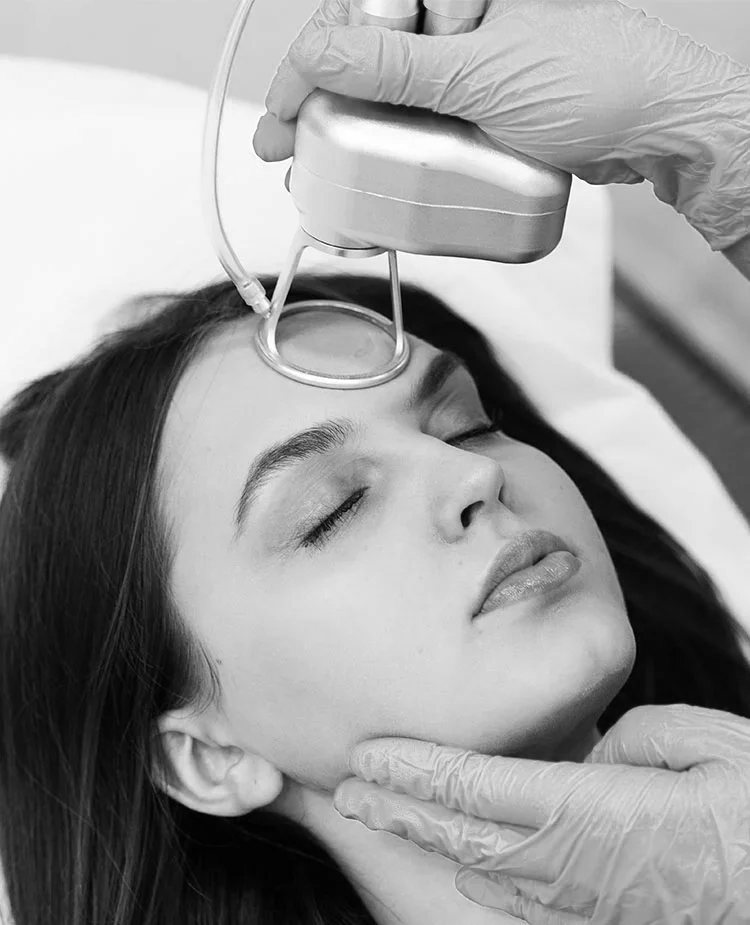
New to laser resurfacing? Read the full guide to CO2 laser resurfacing in Newport Beach — how it works, recovery, and who it's suited to — before booking.
Two resurfacing modalities in one session, performed personally by Dr. Amir Mortazavi, MD.
These treatments work at different depths, which is the reason to combine them. Microneedling creates controlled micro-injuries that trigger collagen remodeling below the surface. Fractional CO2 laser ablates columns of surface tissue and delivers heat into the dermis, driving a stronger repair response above it.
Run together, they address surface texture and deeper structural change in a single visit rather than across two separate appointments and two separate recoveries.
Treats: rough or uneven texture · fine lines and early wrinkles · enlarged pore appearance · textural acne scarring · general skin quality and tone · sun damage
Recovery: expect redness and a sandpaper-like texture for several days as the treated surface sheds. Most patients are presentable in about five to seven days. Diligent sun protection during healing matters more than any product you apply afterward.
Not the right treatment for everyone. Significant skin laxity needs surgery, not resurfacing. Active acne should be controlled first. Deeper skin tones require conservative settings and sometimes a different device — Dr. Mortazavi will say so at consultation rather than treating anyway.
New to GLP-1 therapy? Read the full guide to medical weight loss in Newport Beach — how GLP-1 medications work, what to expect month by month, and who they're appropriate for — before starting.
Physician-supervised GLP-1 therapy, managed personally by Dr. Amir Mortazavi, MD.
GLP-1 medications work on appetite regulation and metabolic signaling rather than stimulant effects. This is prescription medical care, not a wellness product — which means dosing is titrated to your response, side effects are managed as they arise, and progress is monitored over time.
Low Dose — starting point for most patients. Lower dosing reduces the nausea and GI effects that cause people to quit in the first month.
Medium Dose — for patients continuing therapy after tolerating the starting dose, or transitioning from another provider.
What's included: physician consultation and medical history review · prescription and medication · dose titration based on your response · ongoing monitoring and side-effect management.
Worth knowing before you start: meaningful weight loss commonly causes facial volume loss — sometimes called "Ozempic face." Planning for it early is easier than correcting it later. More on GLP-1 facial volume loss →
Dr. Mortazavi will tell you at consultation whether GLP-1 therapy is appropriate for you, and will say so if it isn't.
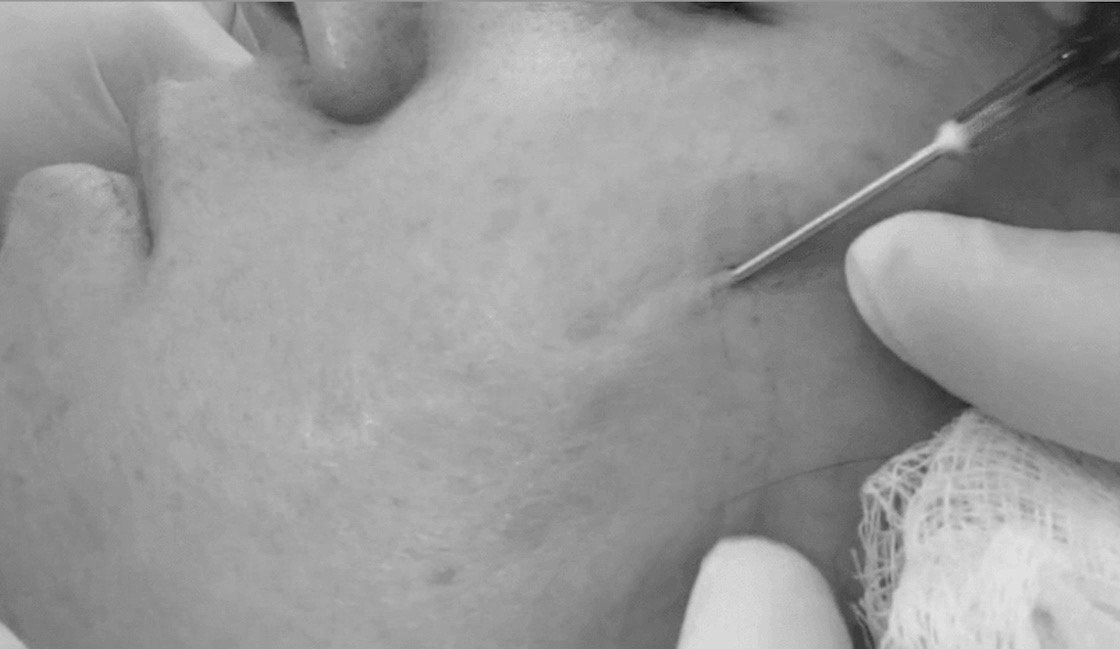
New to subcision? Read the full guide to acne scar subcision in Newport Beach — what it treats, how many sessions you'll need, and what recovery looks like — before booking.
A four-part protocol for tethered acne scarring, performed in a single visit by Dr. Amir Mortazavi, MD.
Depressed acne scars are not a surface problem. A rolling scar is skin tethered downward by fibrous bands beneath it — which is why resurfacing alone often disappoints. You can smooth the surface repeatedly and the depression stays, because the thing pulling it down was never addressed.
This protocol treats all four components in one session.
Subcision — a cannula is passed beneath the scar to sever the fibrous bands tethering it. The skin releases and lifts. This is the only step that addresses the tethering itself; no laser or filler does it.
Sculptra — a collagen biostimulator placed into the space created by subcision. This matters more than it sounds: without something occupying that space, the released tissue can simply re-adhere as it heals. Sculptra keeps it open while stimulating your own collagen to build in the depression.
Laser Resurfacing — addresses the surface component subcision doesn't touch: texture, pore appearance, and tone across the treated area.
Red Light Therapy — applied afterward to reduce post-procedure inflammation and support the healing response.
Why sequence matters. Release first, fill the space, resurface the surface, calm the inflammation. Done in that order, in one session, each step supports the next. Done separately across four appointments with four recoveries, the timing advantage is lost — and most practices can't do it in one visit because they don't offer all four modalities.
Best suited to: rolling scars and tethered depressions · scars that can be seen to lift when the skin is stretched · patients who have tried resurfacing alone without adequate improvement
Less suited to: narrow deep ice-pick scars, which often need TCA CROSS or punch techniques instead · boxcar scars with sharp defined edges, which respond differently · active acne, which should be controlled first
Dr. Mortazavi assesses scar type at consultation. Most faces have more than one type, and the mix determines whether this protocol is the right primary approach.
What to expect: treatment takes 60 to 90 minutes with numbing. Expect bruising — subcision causes bleeding under the skin by design, and this is more bruising than most cosmetic treatments. Plan for seven to ten days. Swelling for several days is normal.
Most patients need more than one session. Depending on scar depth and extent, typically two to four, spaced roughly six to eight weeks apart. Improvement is progressive — Sculptra's collagen contribution builds over three to six months after each session, so the result at three months is not the final result.
Realistic outcome: meaningful improvement in depth and texture. Not erasure. Scarring that took years to form does not resolve completely, and anyone promising smooth skin from a single protocol is overselling. Patients who understand that going in are consistently the ones happiest with what they get.
Giveaways, referral credits, discounts, promotions and specials cannot be combined . One applicable promo/special per visit.Giveaways and treatment credits, including promotional gift cards are not applicable to promotional and special pricing.
New to combination resurfacing? Read the full guide to Pico + CO2 combination resurfacing in Newport Beach — what it treats, recovery day by day, and who it suits — before booking.
Two lasers, one session, one recovery. Performed personally by Dr. Amir Mortazavi, MD.
Sun-damaged skin has two separate problems. Pico shatters pigment photoacoustically — sun spots, uneven tone, post-inflammatory marks. Fractional CO2 ablates and remodels surface tissue — texture, fine lines, pores, scarring.
Treating them separately means two courses of treatment and two healing periods. This addresses both in one appointment.
Treats: sun spots and age spots · uneven skin tone · rough or uneven texture · fine lines · enlarged pore appearance · textural acne scarring · post-inflammatory marks left after acne
The clearest case is acne aftermath — textural scarring and flat brown marks are two different problems in the same square inch of skin, and treating one leaves the face visibly half-corrected.
Suitable for Fitzpatrick skin types I–IV. Deeper skin tones carry higher post-inflammatory pigmentation risk with ablative CO2 — an Erbium-based approach is generally safer, and that's assessed rather than assumed.
Recovery is comparable to CO2 alone, typically extended by a day or two. Expect redness, swelling, and shedding across roughly the first week, with most patients presentable by days six to nine. Treated pigment darkens before it flakes away — that's expected.
Plan on two to three sessions spaced six to eight weeks apart. Pigment usually responds first; textural change builds across the series.
Consultation required before booking. Parameters are individualised to your skin type, pigment depth, and degree of textural change — and sometimes the right answer is a single modality rather than two. Dr. Mortazavi will tell you which.